





Eye For Film >> Movies >> Backrooms (2026) Film Review


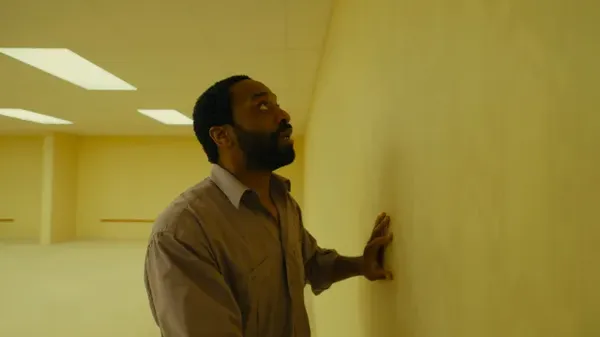

It is difficult to enter Backrooms without seeing it as a long-forgotten Severance set. Kane Parsons’ feature debut even uses a title treatment that recalls the Apple TV series, though here the blues, greens and sterile whites of corporate dread have mildewed into oppressive yellows. No one, of course, owns the ubiquity or liminality of office spaces, but Backrooms immediately situates itself within that same architectural anxiety – the horror of places designed to be passed through, worked in, forgotten or abandoned.
There was a time when an idea, or at least a work of art, usually moved from conception to execution as a largely private affair, solidifying the auteur stamp of its maker before entering the world. Parsons’ achievement, still not old enough to drink under American law, is almost the opposite. With Backrooms, he doesn’t take a public-domain nightmare but a social-media-shared moment: the ephemeral hype of an imageboard post, transformed into lore, then into a YouTube phenomenon, and now into a major motion picture from A24, “an indie studio with major-studio aspirations”. The origins matter because aside from the mostly empty rooms, the film is haunted by the strange continuity of online culture itself: from 4chan, a platform now radioactive for its association with misogynistic campaigns and conspiracy theories, to YouTube short, to multiplex-ready prestige horror technically based on the preceding YouTube short.

Set in 1990 in the suburbs of San Jose, California, it follows Clark (Chiwetel Ejiofor), a struggling furniture-store owner separated from his wife and reduced to sleeping inside his own big-box retail warehouse, the kind of building landlocked by atrociously large parking lots and blank façades. Clark goes to therapy, where Dr Mary Kline (Renate Reinsve) asks him to roleplay what he should have said to his wife. Woven through the film is Kline’s own buried trauma: a mother who struggled with mental health, and a childhood home bulldozed to make room for new developments.
Parsons and his screenwriter, Will Soodik, make strong use of these spatial motifs: Kline’s demolished home, Clark’s failed architectural ambitions, the soulless retail box that becomes both workplace and tomb. When Clark discovers the backrooms by walking through a wall in one section of the store, ripples appear on screen. These will appear intermittently throughout the film, and only at the point of entry, as if the image itself is suffering a structural defect. The spaces beyond are creepy, endless, and occupied by looming presences. Clark returns to tell his therapist, then recruits two young adult employees to help him record what he has found. Horror, predictably, ensues.
And yet, for all the atmosphere Parsons can summon, Backrooms struggles to fully contend with itself as a motion picture. Its images are often chilling. Its spaces have a genuine charge. But the plot often feels less like cinema than like a sequence of cutscenes from a video game with the gameplay removed. That is not inherently fatal: recent films such as Exit 8 have also emerged from or are adjacent to game logic, and horror has always borrowed freely from other forms. The problem here is that Backrooms too often mistakes the suggestive power of an environment for dramatic momentum.
It undeniably belongs to the age of aesthetic-maxxing: all vibes, all creep, very little fully developed substance. Parsons’ visual instincts are obvious, sometimes startlingly so, but the script underneath them feels underbaked. There is an interesting tension in a director born in 2005 setting his debut in 1990, not as nostalgia exactly, but as inherited memory: a past reconstructed through texture, architecture and analog unease rather than lived experience. But that distance also shows. The period sometimes feels less observed than selected, as if 1990 were simply the most useful container for fluorescent dread, camcorders and pre-internet isolation.
Still, Backrooms clearly demonstrates Parsons’ talent. The question is whether that talent can exist outside the conditions that produced it: social-media hype, adaptation, internet folklore, the ready-made mythology of collective unease. The film is strongest when it suggests that spaces remember people haphazardly, cruelly, and without meaning. That may also be how Backrooms itself is remembered: as a frightening environment in search of a more fully inhabited film.
Parsons has made a work that understands corridors, fluorescent light and corporate emptiness better than it understands people. Maybe his next step is not deeper into the backrooms, but into the hidden rooms of his own visual intelligence.
Reviewed on: 08 Jun 2026



Director: Kane Parsons
Writer: Will Soodik
Starring: Chiwetel Ejiofor, Renate Reinsve, Mark Duplass, Finn Bennett, Lukita Maxwell, Avan Jogia, Robert Bobroczkyi, Ember Ambrose, Krista Kosonen, Philip Granger, Katharine Isabelle, Peter New, Sarah Hayward, Natalie Moon, Calix Fraser
Year: 2026
Runtime: 111 minutes
BBFC: 
Country: US, Canada
Festivals:
Search database: